When your GE refrigerator stops cooling properly or needs a replacement water filter, the first thing a repair tech or parts supplier will ask for is the model number. Without it, you’re stuck guessing which parts fit, whether a recall applies, or if that YouTube repair video even matches your unit. The model number is stamped somewhere on nearly every GE fridge ever made, but finding it isn’t always obvious, especially on side-by-side or French door models with multiple compartments. This guide walks through the most common locations, explains what those letters and numbers actually mean, and covers what to do when the label’s missing or unreadable.
Table of Contents
ToggleKey Takeaways
- The GE refrigerator model number is a unique identifier found inside the fresh food or freezer compartment that tells you exact configuration, capacity, and manufacturing details needed for parts ordering and warranty service.
- Model number labels are most commonly located on the sidewall of the fresh food compartment near the top, behind shelving brackets, or inside the freezer on side-by-side units.
- GE model numbers follow a logical structure where the first letter indicates product line (P for Profile, G for standard GE), middle characters encode configuration and capacity, and last letters denote finish color like stainless steel.
- If your GE refrigerator model number label is missing or unreadable, check your original purchase paperwork, warranty card, GE Appliances online account, or contact customer service at 1-800-626-2005 with photos and dimensions.
- Taking a photo of your model number label and saving it to your phone records ensures quick access when ordering replacement parts, scheduling repairs, or checking for recalls without guessing.
Why You Need to Know Your GE Refrigerator Model Number
The model number is the unique identifier for your specific refrigerator. It tells you the exact configuration, capacity, color, and manufacturing details that separate your unit from the hundreds of other GE models produced over the decades.
Here’s when you’ll need it:
• Ordering replacement parts. Water filters, door bins, shelves, compressors, and control boards are all model-specific. A part that fits a GE Profile PSS28KSHSS won’t necessarily work on a GE GSS25GSHSS, even if they look identical.
• Scheduling warranty or repair service. Technicians use the model number to pull schematics, check warranty status, and bring the right parts on the first visit.
• Checking for recalls or service bulletins. GE occasionally issues safety recalls or technical service bulletins for specific model ranges. You can’t verify eligibility without the exact model.
• Researching specs and manuals. Need to know if your fridge uses R-134a or R-600a refrigerant? Whether it’s ADA-compliant? The model number unlocks the original spec sheet and installation manual.
• Reselling or upgrading. Buyers want to know capacity, age, and features. The model number provides all of that in a searchable format.
Without the model number, you’re left measuring dimensions, describing features, and hoping the parts desk gets it right. It’s worth the two minutes to locate it now and snap a photo for your records.
Where to Find the Model Number on Your GE Refrigerator
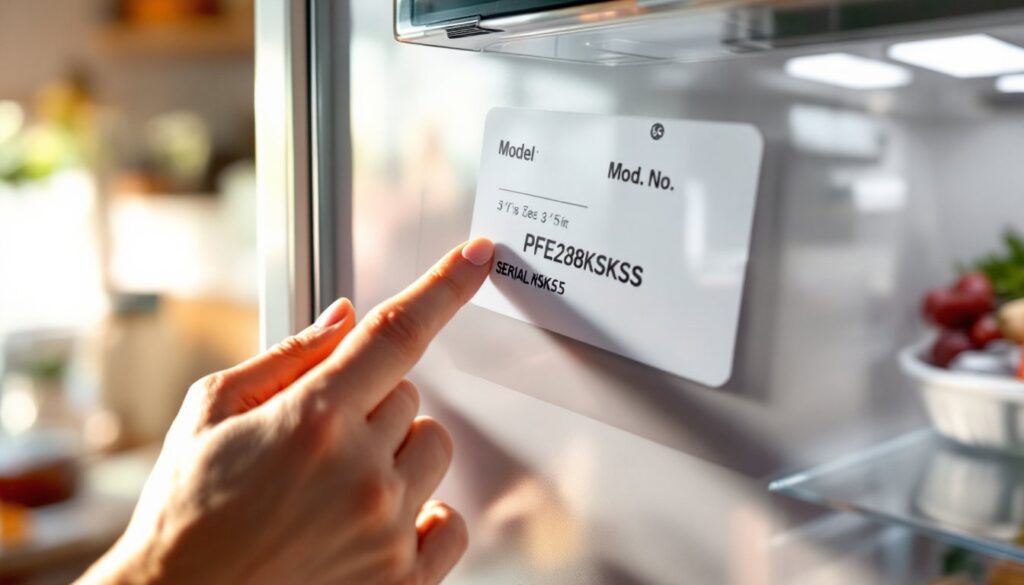
GE has shifted the location of the model number label over the years, but it’s almost always inside one of the refrigerator compartments, not on the back or bottom. The label is a white or silver sticker, usually about 3×5 inches, with a barcode and several lines of text. Look for the words “Model” or “Mod. No.” followed by a string of letters and numbers.
Inside the Fresh Food Compartment
This is the most common spot on top-freezer, bottom-freezer, and French door models made after 2000.
Check the left or right side wall, near the top, just behind where the door closes. On some units, it’s tucked up high near the ceiling of the compartment. You may need to pull out the top shelf or remove a crisper drawer to see it clearly.
On French door models, the label is often on the upper-left or upper-right sidewall, above the crisper drawers. If your fridge has a slide-out drawer in the middle (like a deli or freezer drawer), the label might be on the front face of that drawer assembly when it’s pulled out.
Watch for: The label can be hidden behind or underneath shelving brackets, especially on models with adjustable glass shelves. Run your hand along the sidewall if you don’t see it immediately.
On the Freezer Door or Frame
Some side-by-side and older top-freezer models place the label inside the freezer compartment instead.
Side-by-side units: Open the freezer door and check the upper-left or upper-right corner of the interior wall. It’s usually above the top shelf or ice bucket.
Top-freezer models (pre-2000): The label may be on the underside of the freezer door, visible when you pull the door open fully, or on the interior frame just inside the freezer cavity.
Chest freezers and standalone units: If you’re hunting for a model number on a standalone GE freezer, check the interior sidewall near the top or on the exterior back panel near the compressor.
If you still don’t see it, remove all shelves and bins from both compartments and inspect every interior surface. The label is there, it’s just playing hide-and-seek.
How to Read and Decode Your GE Model Number
GE model numbers look like alphabet soup, but they follow a logical structure. A typical GE Profile or GE Appliances fridge model number might look like this: PFE28KSKSS or GTS18GTHWW.
Here’s the breakdown:
• First letter(s): Indicates the product line. P = GE Profile, C = Café, G = standard GE, Z = Monogram. Some models start with two letters (e.g., GS for side-by-side).
• Middle characters: Encode the configuration, capacity, and features. F often means freezer-on-bottom, S can indicate side-by-side, T for top-freezer. Numbers represent cubic footage or generation.
• Last letters: Finish color or trim. SS = stainless steel, BB = black, WW = white, CC = bisque.
For example, PFE28KSKSS breaks down as:
- P = Profile series
- FE = French door, freezer on bottom
- 28 = approximately 28 cubic feet
- K = generation or feature set
- SK = sub-model variant
- SS = stainless steel
You don’t need to memorize this, but understanding the pattern helps when you’re comparing parts or reading appliance reviews to see if a fix applies to your unit.
Serial number: The label also includes a serial number, usually starting with two letters followed by six digits (e.g., FA123456). The first two letters indicate the month and year of manufacture. GE uses a rolling letter code, so decoding the exact date requires a lookup table, but the serial number is critical for warranty claims and recalls.
Write it down. Take a photo of the entire label with your phone and save it in a note titled “GE Fridge Model.” You’ll thank yourself the next time you need to order a water filter at 9 p.m.
What to Do If You Can’t Find Your Model Number
Sometimes the label has peeled off, faded into illegibility, or was removed by a previous owner. Here’s how to track down your model number when the sticker’s gone.
Check your original paperwork. The model number is printed on the purchase receipt, warranty card, and installation manual. If you registered the appliance with GE when you bought it, log into your GE Appliances account online, the model number should be saved there.
Look for a secondary label. A few GE models have a duplicate label on the back panel, near the compressor or on the top edge of the unit. You’ll need to pull the fridge away from the wall and possibly remove the rear access panel. Safety first: Unplug the fridge before you start poking around the back. Many home improvement projects require similar precautions when working with appliances.
Measure and photograph the unit. If you absolutely can’t find the label, measure the exterior dimensions (height, width, depth) and take clear photos of the front, interior, and any distinctive features (ice maker type, door handles, control panel layout). Call GE Appliances customer service at 1-800-626-2005 with those details. They can often narrow it down to a handful of models, especially if you know the approximate age and where you bought it.
Use the GE Appliances website. Go to the GE Appliances support site and browse by product type and configuration. Filter by features (French door, water dispenser, etc.) and compare photos. This won’t give you a definitive match, but it can help you create a shortlist.
Check your home inspection or appraisal report. If you bought the house recently, the inspector or appraiser may have documented the appliance model numbers. Real estate agents sometimes include this in listing photos or disclosures as well.
Ask the previous owner. If you bought the home or fridge secondhand, reach out. They may still have the manual or a photo of the label.
When all else fails: If you need parts or service and truly can’t identify the model, bring the broken component (like a broken shelf or water filter) to an appliance parts store. Experienced counter staff can sometimes reverse-engineer the model from the part itself. Kitchen experts often recommend this approach when dealing with older or obscure appliance models.
One last tip: if you’re replacing parts without a confirmed model number, buy from a retailer with a generous return policy. Ordering the wrong compressor or control board gets expensive fast.
Conclusion
Finding your GE refrigerator model number takes about two minutes once you know where to look, usually inside the fresh food compartment on the sidewall or in the freezer section. Snap a photo of that label and keep it handy. Whether you’re ordering a $15 water filter or troubleshooting a compressor issue, that string of letters and numbers will save you time, money, and a lot of frustration down the road.