When the lights go out, your first thought probably isn’t about the pot roast in the fridge, until you remember that power outage could turn your groceries into a biohazard. Whether it’s a storm, a grid failure, or a tripped breaker you can’t reset until morning, knowing how long your refrigerator stays cold without power can save you hundreds of dollars in wasted food and prevent a nasty bout of food poisoning. The clock starts ticking the moment the compressor stops, and the margin for error is smaller than most people think.
Table of Contents
ToggleKey Takeaways
- A refrigerator stays cold and safe for only 4 hours without power if the door remains closed, making it critical to keep the fridge sealed during outages.
- Freezers maintain safe temperatures for 24 to 48 hours depending on how full they are, with chest-style freezers outperforming upright models due to better cold air retention.
- Door seal condition, ambient temperature, and fullness of the unit are the biggest factors affecting how long your refrigerator holds cold during power loss.
- After power is restored, use an appliance thermometer to verify food safety—items above 40°F for more than two hours should be discarded regardless of appearance or smell.
- Keeping the door closed is the single most effective action you can take to extend cold retention, as each opening rapidly raises internal temperature and wastes your safety window.
- For outages longer than 4 hours, transfer perishables to coolers with ice packs, use dry ice carefully, or move food to a secondary freezer if available.
How Long Food Stays Safe When the Power Goes Out
The USDA Food Safety and Inspection Service sets clear benchmarks for how long refrigerated and frozen food remains safe during outages. These aren’t rough estimates, they’re backed by food science and thermal testing. Treat them as hard deadlines, not suggestions.
Refrigerator: 4 Hours With Doors Closed
A standard refrigerator will hold a safe temperature (below 40°F) for approximately four hours if you keep the door shut. That’s it. Not “most of the day” or “until it feels warm.” Four hours.
This assumes your fridge was operating at the correct temperature before the outage (ideally 37°F to 38°F). If you’ve been running it warmer, or if it’s an older unit with worn door seals, you’re working with even less time. The internal temperature rises faster than you’d expect, especially in warmer ambient conditions or if the fridge is less than half full, there’s less thermal mass to hold the cold.
Opening the door even once cuts into that four-hour window. Every time you crack it open to “check,” you’re bleeding cold air and accelerating spoilage. Resist the urge.
Freezer: 24 to 48 Hours Depending on Fullness
A full freezer will maintain a safe temperature (below 0°F) for approximately 48 hours with the door closed. A half-full freezer drops to around 24 hours. The difference comes down to thermal mass, frozen food acts like ice packs, keeping neighboring items cold.
If your freezer is a chest-style model, you’re in slightly better shape than with an upright. Cold air is denser than warm air, so it doesn’t escape as quickly when the door’s horizontal. Upright freezers lose cold faster every time the door swings open, since the cold air literally falls out.
Again, these timelines assume you don’t open the door. Not even to move things around or consolidate items. Every opening costs you hours of safety margin.
What Affects How Long Your Fridge Stays Cold
The four-hour and 24-to-48-hour windows are guidelines, not guarantees. Several factors influence how quickly your appliance warms up.
Door seal condition is the biggest variable. If the gasket around your fridge or freezer door is cracked, torn, or no longer seals tightly, cold air escapes continuously, even when the door’s shut. Test this by closing the door on a dollar bill: if you can pull it out easily, the seal’s compromised. Replace it.
Ambient temperature matters more than people realize. A fridge sitting in a 90°F garage during a summer outage will warm far faster than one in a climate-controlled 70°F kitchen. If you’re in a hot climate or it’s mid-summer, subtract an hour from the standard estimates.
How full the fridge is impacts thermal retention. A well-stocked fridge holds cold longer because the food itself acts as a cold reservoir. An empty fridge is just insulated air, which warms quickly. Same principle applies to freezers, pack them tight if you know a storm’s coming.
Frequency of door openings is the killer. Each time you open the door, you’re exchanging cold interior air for warm room air. Studies show a single 10-second door opening can raise the internal temperature by several degrees, and it takes the compressor significant time to recover, time you don’t have during an outage.
Age and efficiency of the unit also play a role. Newer fridges often have better insulation and more efficient door seals. An old fridge from the ’90s might not hold cold as well as a modern Energy Star-rated model, even if it’s still running fine otherwise.
How to Maximize Cold Retention During an Outage
If you know an outage is coming, or if one’s already started, take these steps immediately to extend your safety window.
Keep doors closed. This is the single most effective thing you can do. Don’t open the fridge or freezer unless absolutely necessary. No peeking, no rearranging, no “just grabbing one thing.” Treat it like a sealed cooler.
Group frozen items together. If you have advance warning, consolidate everything in your freezer into the center or one section. Packed-together items stay colder longer. If your freezer’s half-empty, fill clean containers with water and freeze them as makeshift ice blocks.
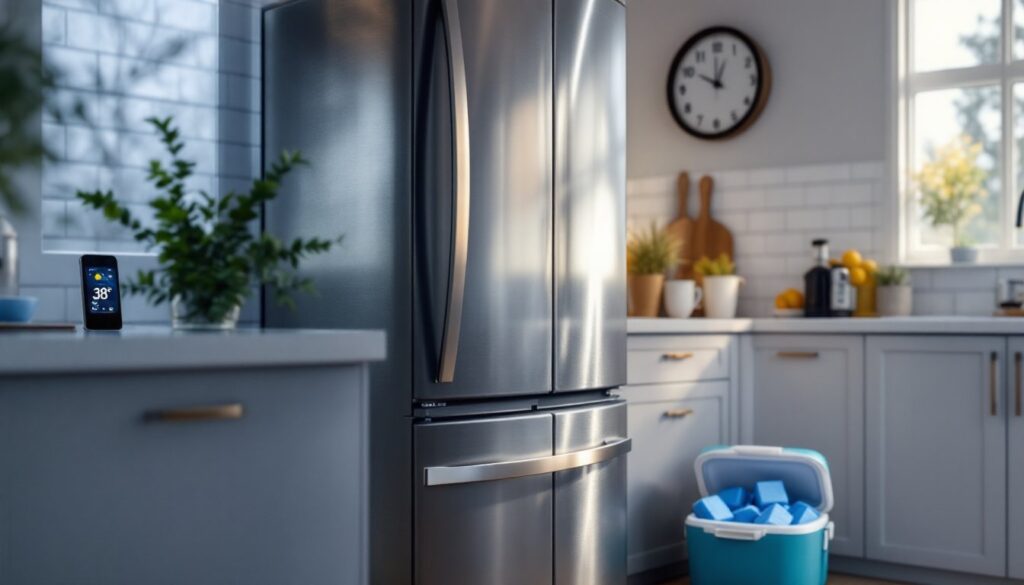
Use appliance thermometers. If you don’t already have them, keep an appliance thermometer in both the fridge and freezer. They’re cheap (under $10) and invaluable during an outage. Once power’s restored, you’ll know immediately whether your food stayed in the safe zone or crossed into the danger zone.
Add ice or dry ice if the outage will be extended. For outages expected to last longer than four hours, transfer perishables to a cooler with ice packs or buy dry ice for your freezer. Dry ice keeps a freezer at safe temps for days if used correctly. Handle it with heavy gloves, it’s cold enough to cause frostbite on contact, and never seal it in an airtight container: sublimating CO₂ can build pressure.
Avoid using generators indoors. If you’re running a portable generator to power your fridge, never operate it inside your home, garage, or near windows. Carbon monoxide buildup can be fatal. Keep it outdoors, at least 20 feet from the house, and use a heavy-duty outdoor-rated extension cord to plug in the fridge.
Move food to a secondary freezer if you have one. A packed chest freezer in the basement will outlast your kitchen fridge freezer by a wide margin. Transfer high-value or highly perishable items if you’ve got the space.
What to Keep and What to Throw Away After Power Loss
Once power’s restored, don’t just assume everything’s fine because it still feels cool. Use your appliance thermometer and follow food safety guidelines to decide what’s salvageable.
Refrigerator items: If the fridge stayed at 40°F or below, everything’s safe. If it rose above that, evaluate item by item. Hard cheeses, butter, and most condiments (ketchup, mustard, hot sauce) are generally fine. Toss meat, poultry, seafood, deli meats, soft cheeses, milk, eggs, and leftovers if they’ve been above 40°F for more than two hours. Yes, two hours, not four. The four-hour rule is how long the fridge holds cold, not how long food tolerates warmth.
Freezer items: If food still contains ice crystals or feels as cold as if refrigerated (below 40°F), it’s safe to refreeze, though texture and quality may suffer. If it’s fully thawed and been above 40°F for more than two hours, treat it like you would refrigerated items. Meat, seafood, and anything with dairy should be discarded. Bread, fruit, and vegetables can usually be refrozen.
When in doubt, throw it out. Food poisoning isn’t worth the $15 you’ll save on a pack of chicken thighs. Bacteria like Salmonella and E. coli multiply rapidly in the “danger zone” between 40°F and 140°F, and they don’t change the smell, appearance, or taste of food.
Don’t rely on smell or appearance. Spoiled food often looks and smells fine in the early stages of bacterial growth. Trust the thermometer and the timeline, not your senses.
Document losses for insurance or tax purposes. If you lose a significant amount of food due to an extended outage, take photos and keep receipts. Some homeowners or renters insurance policies cover spoiled food, and the IRS may allow casualty loss deductions in federally declared disaster areas.
Conclusion
A refrigerator without power is a ticking clock, not a long-term storage solution. Four hours for fresh food, 24 to 48 for frozen, those are your margins. Keep the doors closed, use thermometers, and when power returns, be ruthless about what you toss. Your gut might say it’s fine, but food safety doesn’t negotiate.